 Behavly
Behavly vs Vero
Vero sends the message your team wrote for each step; Behavly Agent writes each follow-up at send time from one person’s own product activity. Features and prices.
Vero and Behavly both email the users of a SaaS product based on what those users did. Where they split is who writes the email. In Vero, your team writes a message for each step of a journey, and Vero sends that message to everyone who reaches the step. Behavly holds the writing until an email is due, then writes it for the one person receiving it, from what they did in your product.
A disclosure first: Behavly is our product. What we say about Vero comes from getvero.com and its documentation, read on November 20, 2026, with a link wherever a claim appears. What we say about Behavly comes from its Help Center.
Why teams pick Behavly over Vero
- One person per email, not one email per step. When two users reach the same step, each gets an email about their own activity. Vero has no built-in writer: its MCP server, in early access, connects your own assistant, such as Claude or ChatGPT, to help with copy that your team then sends to everyone at that step.
- Tracking starts from one script tag. Behavly records every signed-in user’s clicks, page views, scroll depth and pointer movement, with no identify call and no event schema to plan. Vero’s JavaScript SDK works from the identify and track calls your developers add, plus a site-visit event.
- Heatmaps down to one user. Behavly shows where a single person clicked, where they got stuck and where they stopped scrolling, next to the emails it writes them. Vero’s pages list no heatmaps.
- One product, settled. Vero runs two versions side by side while it brings Vero 2.0 up to Vero 1.0, and its 2.0 journeys are labelled beta. Behavly’s campaigns, paths and triggers are one product, on every plan.
- Each reader’s language, detected. Behavly writes each email in the reader’s own language, from 23, with nothing to translate. Vero’s languages feature sends a stored version per language, picked from each person’s locale.
- Sent from your own mailbox. Each email reads as a note from one person, and a reply lands beside the sender’s whole history on your site.
- A free plan you can send from. Behavly’s free plan has no time limit. Vero has a 14-day trial, and live sending needs a paid, verified account.
Side by side
| Behavly | Vero | |
|---|---|---|
Built around | Each person: all of one signed-in user’s activity, combined across the browsers they use | Profiles and events, with audiences that can also come from your data warehouse |
Who writes the emails | Behavly, writing for each recipient at send time; or a template of yours, sent exactly as you designed it | Your team writes each message; your own AI assistant can draft copy through Vero’s MCP server |
How data gets in | A script tag on your website and in your app, with no identify call; behavly.track for product actions; send_event for backend events | JavaScript SDK, Track API, Segment or RudderStack; audiences by read-only SQL against Snowflake, BigQuery, Redshift, Postgres, MySQL or SQL Server |
What it records on your site | Every signed-in user’s clicks, page views, scroll depth and pointer movement | The events you send with identify and track calls, plus a site-visit event when pageview tracking is on |
Heatmaps | Yes, on all plans: site-wide or for a single person | Not listed |
Journeys | Paths with waits and branches on logins, page visits, product actions, replies, opens and clicks; described in plain words or built step by step; edit an active path and choose Publish changes | Vero 2.0 journeys are labelled beta, start on events, and must be stopped before they’re changed |
A/B tests | On any email step, scored against the path’s goal | Random Split steps divide a journey into 2 to 26 paths |
Languages | Detected per reader; each email written in that person’s language, from 23 | A stored version per language, picked from each person’s locale; email first, with push and SMS rolling out |
Sends from | Your own mailbox over IMAP/SMTP, or an email service you connect by API key, such as Resend, Amazon SES, Postmark or SendGrid | Vero’s built-in mailer (“via veromailer.com” until you add your domain), a custom domain, or your SendGrid, Mailgun, Mailjet or Mandrill account |
Other channels | SMS through your own Twilio account (Professional plan); push through your own Amazon SNS | |
Replies | Arrive in Behavly’s inbox next to what the sender did on your site; Reply with Behavly drafts a response | No inbox; replies go to the reply-to address you set on the sender |
Approval | Optional: Approval holds each email Behavly writes until you release it; Preview and Test show real emails before you activate | Your team writes and launches every message |
AI apps and API | An MCP server for Claude, ChatGPT, Gemini, Perplexity, Grok, Cursor and more, plus a REST API | An MCP server in early access for Claude, ChatGPT, Gemini Enterprise and Notion, plus APIs |
Free plan | Yes, with no time limit: 100 tracked contacts and 50 personalized emails a month | No; a 14-day trial, with live sending on a paid account |
Paid plans | Starter $79/month (2,500 tracked contacts, 2,000 personalized emails) | Starter $54/month, $49 billed yearly (5,000 profiles, 10,000 emails); Professional priced on usage |
For the wider field, see our Vero alternatives and the behavioral email tools for SaaS we’ve compared.
How we compared
We read Vero’s homepage, pricing, documentation and product updates on November 20, 2026, and set each row against the matching Help Center article for Behavly. Where Vero’s pages didn’t describe something, the table says so rather than guessing.
How Vero works
Vero calls itself a multi-channel customer engagement platform for product-led teams: email, SMS and push, sent when people do something in your product. Profiles and events come in through its JavaScript SDK, Track API, Segment or RudderStack, and audiences can also be pulled from your data warehouse with read-only SQL.
It runs as two versions. Vero 2.0, launched in August 2024, brings together Vero’s original product, now called Vero 1.0, and Vero Connect; the two run side by side while Vero brings 2.0 up to parity with 1.0. Journeys in 2.0 are labelled beta, start on events, and must be stopped before you change them. Your team writes each message, and an AI assistant connected through Vero’s MCP server, in early access, can help with copy.
How Behavly works
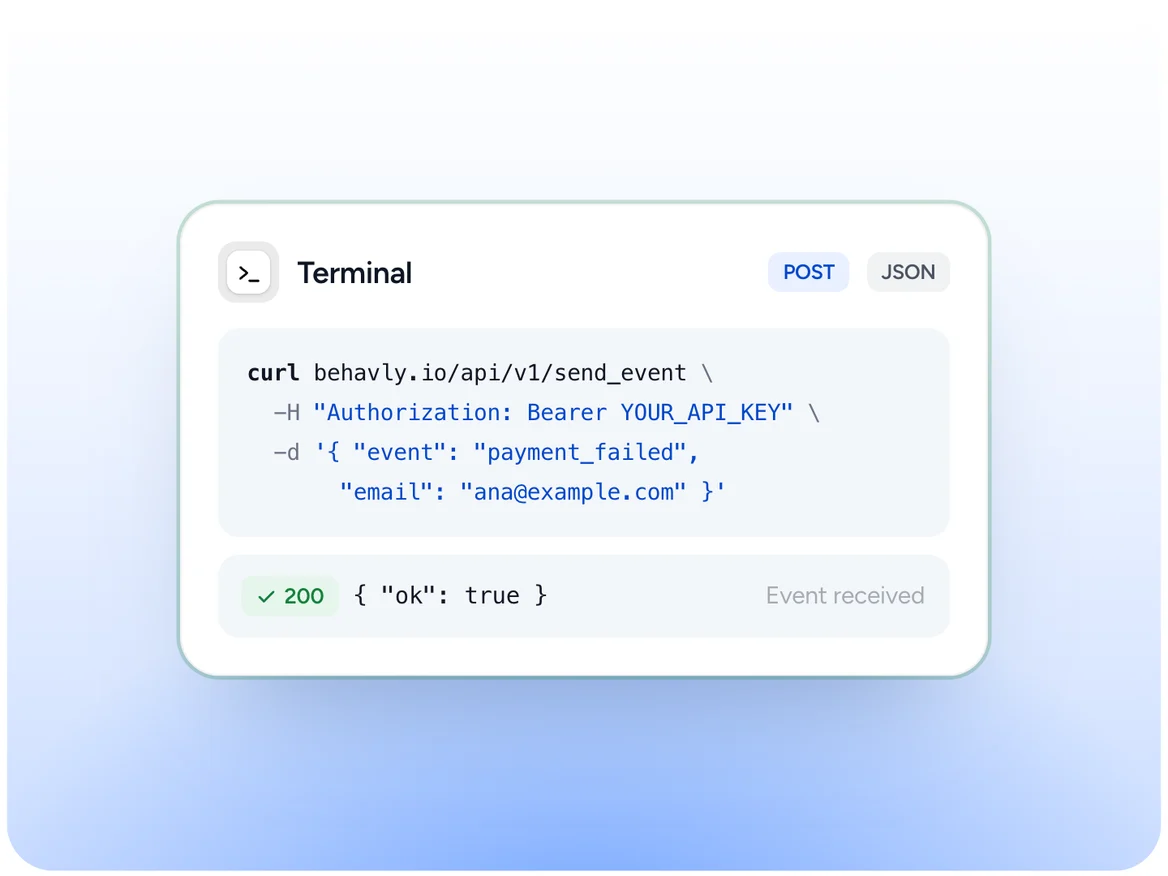
Where Vero starts from the events you send it, Behavly starts by recording what your users do. A single script tag goes on your site and in your signed-in app. Behavly reads the session to know who is signed in, so you never wire up an identify call, and it gathers each person’s actions into one profile across the browsers they use. If you want specific product actions, behavly.track adds them, and your backend can report events such as a failed payment through send_event, which starts a Trigger Campaign for that person right away.
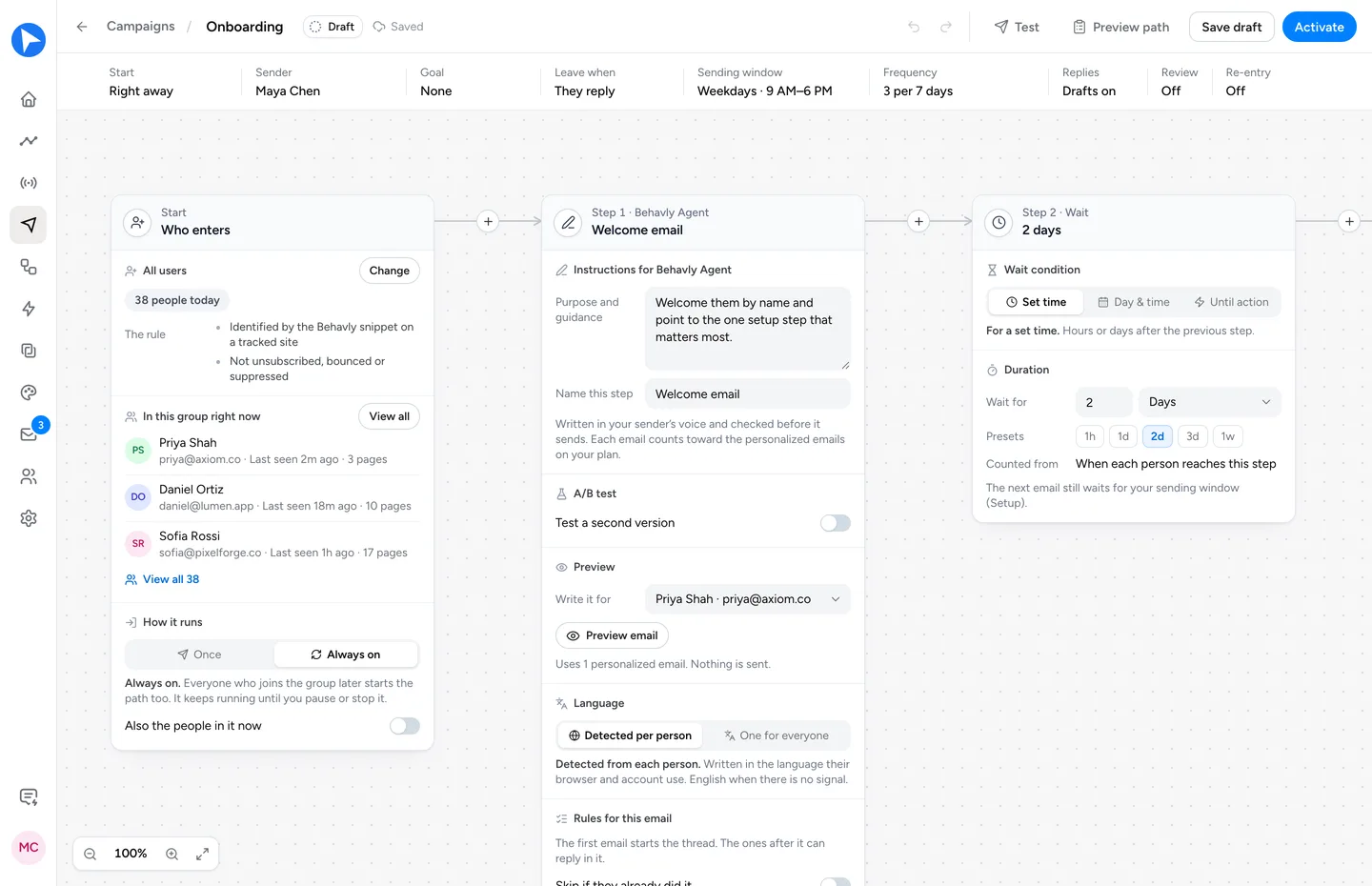
Next comes the audience. Pick a group Behavly spotted in that activity, or describe the group in plain words and check the people who match before saving it. Describe the path you want, and Behavly arranges the steps. A path runs once, stays on for each new person who joins the group, or fires whenever your product sends an event.
Then Behavly writes last. When a person reaches an email step, it reads each earlier email on the path, checks whether they opened or clicked it, and writes this one from their activity, in their language. The email leaves from your own mailbox, and any reply returns to Behavly’s inbox.
Subject: Your Ledgerline trial ends Friday
Hi Priya,
Your trial ends on Friday. This week you built the cash-flow and runway dashboards and shared the runway one with Tom.
Both stay exactly as they are when you move to Pro, and Tom keeps his access. If you’d like more time to decide, reply and I’ll extend it.
Choose a plan: [link]
Nora
The trial date comes from the event’s fields; the dashboards and the share come from Priya’s own activity.
Where Behavly is ahead
- A new email every time. Vero sends the message your team wrote for that step. Behavly writes a new email for each person, in their language, every time one sends.
- No event plan needed for detail. Vero knows the events you send or the rows you query. Behavly gets clicks, page views and scroll depth from one script tag, so a path can branch on which pages a person visited.
- Every email remembers the ones before it. Behavly reads what the path has already sent and how each email landed, so the next one moves the conversation on.
- Change a path while it runs. Edit an active Behavly path and choose Publish changes: newcomers take the new path, and people already on it finish the version they started. Vero 2.0 journeys must be stopped before any change.
- A path that tests itself. Test sends every email on the path, written for one real person, to your own inbox at once. Every Monday, once a campaign has sent 20 emails, a path review suggests what to change.
- Mail that looks personal. Behavly sends from a real mailbox, so each email reads as a note from one person to another, and replies arrive alongside the sender’s activity.
What you pay for
Vero’s Starter plan is $54 a month, or $49 billed yearly, for 5,000 profiles and 10,000 emails, and past those limits its Professional plan is priced on usage. Behavly has four fixed monthly plans, each with a set number of tracked contacts and of personalized emails, the ones Behavly writes for each person, so the writing comes with the plan rather than costing your team hours. Template emails are unlimited on every plan, and so are always-on and Trigger Campaigns.
| Plan | Price | Personalized emails a month | Tracked contacts | Behavior data kept |
|---|---|---|---|---|
Free | $0 | 50 | 100 | 30 days |
Starter | $79/month | 2,000 | 2,500 | 90 days |
Growth | $249/month | 8,000 | 10,000 | 180 days |
Scale | $699/month | 30,000 | 40,000 | 365 days |
Moving over from Vero
- Start with the snippet. Install Behavly’s script on your signed-in pages a couple of weeks before you switch, so the first emails have activity to draw on.
- Bring your profiles over. Export your profiles from Vero and load them into Behavly from a CSV; each person starts collecting activity on their next visit.
- Point your backend events at Behavly. The events your servers send Vero today, such as a failed payment or a trial ending, start a Trigger Campaign in Behavly through
send_event. - Rebuild journeys in words. Sum up each Vero journey in a sentence, let Behavly turn it into a path, and use Preview to read a step as a real user would get it.
- Plan the DNS change. Connecting your mailbox or email service to Behavly means its sending records on your domain; keep Vero sending until the new paths have run long enough to compare.
Still weighing other tools too? See Vero alternatives, or Behavly vs Customer.io for the tool closest to Vero’s model.
Questions
- What is the difference between Behavly and Vero?
- Vero sends the message your team wrote for each step of a journey, triggered by the events you send it. Behavly records what each signed-in user does from one script tag and writes every follow-up email at send time for the one person receiving it, from their own activity.
- Does Vero have AI?
- Vero has no built-in writer. Its MCP server, in early access, connects assistants such as Claude, ChatGPT, Gemini Enterprise and Notion to your Vero account to help with copy. Behavly writes each email itself, for the person receiving it, and has its own MCP server for Claude, ChatGPT and other AI apps too.
- How does Behavly’s price compare with Vero?
- Vero’s Starter plan is $54 a month, or $49 billed yearly, for 5,000 profiles and 10,000 emails, with Professional priced on usage. Behavly’s Free plan covers 100 tracked contacts and 50 personalized emails a month with no time limit, and Starter is $79 a month for 2,500 tracked contacts and 2,000 personalized emails. Template emails are unlimited on every Behavly plan.
- Can I move my Vero events to Behavly?
- Yes. Send the same backend events to Behavly with
send_eventand each one starts a Trigger Campaign for that person, with the event’s fields available in the email. Behavly’s script tag adds what people do on your site and in your app, with no event schema to plan. - Is Vero shutting down?
- No. Vero is moving customers from Vero 1.0 to Vero 2.0, and both run side by side while 2.0 reaches parity with 1.0.