
The audience is either everyone, a behaviour pattern, or a hand-picked list.
All Users
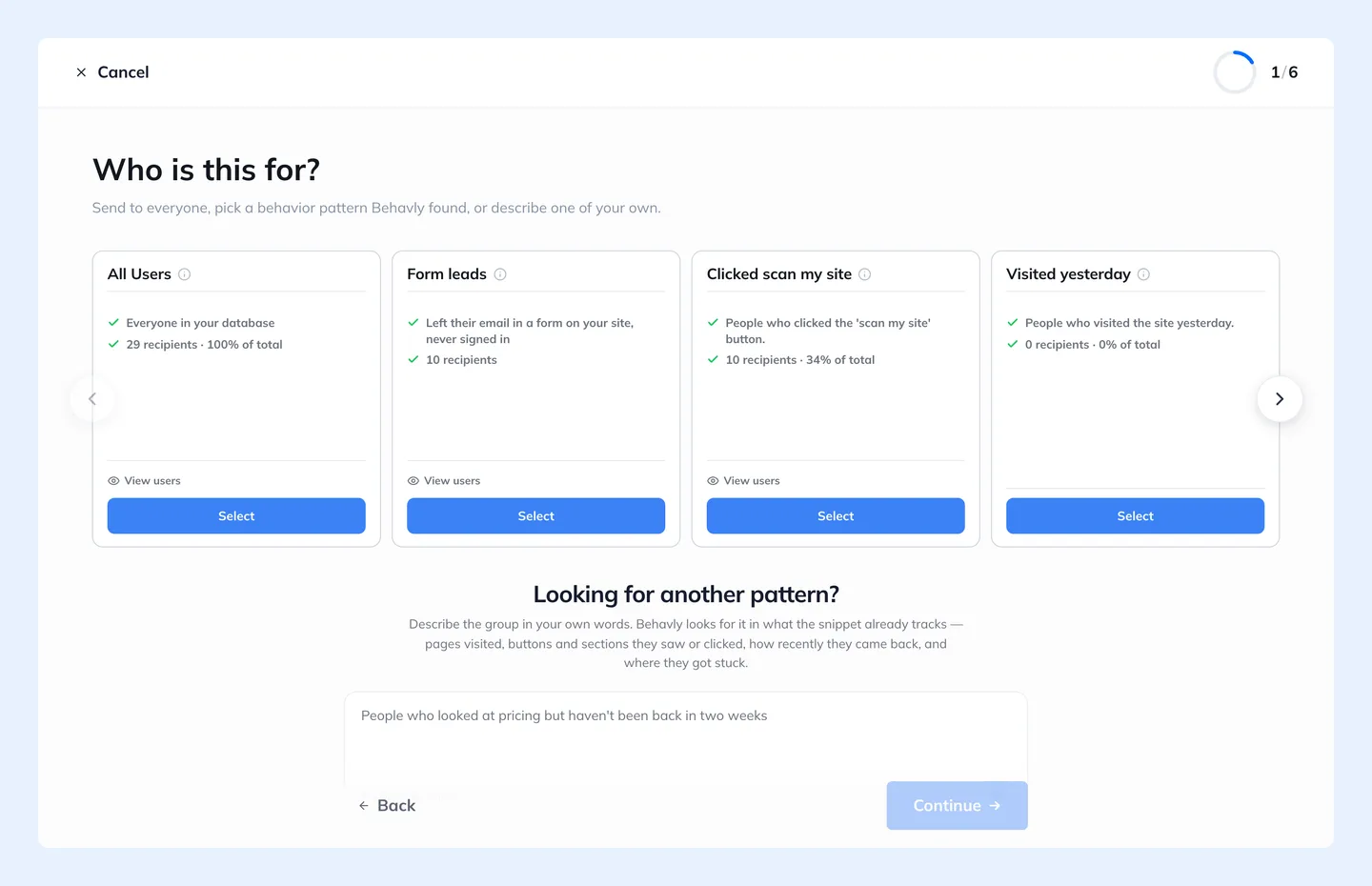
Everyone in your database for the selected site.
A Detected Pattern
Behavly reads your tracked behaviour and offers patterns it found — groups of people who did something in common. Each card carries an explainer that spells out the actual rule behind it, because a name like *Barely explored* is a label, not a definition.
Ask For A Pattern
Describe the group you want in plain language and Behavly turns it into a rule. The description is matched against a closed vocabulary of behavioural rules — it does not write a database query, and it cannot invent a rule Behavly does not support.
You are shown the resulting group and its size before anything is saved. That preview is the point: it is where you catch a description that was read differently than you meant it.
Form Leads
People who arrived through one of your forms rather than by signing in. They are a separate card, and they are excluded from All Users — a lead is not yet a user, and mixing the two makes both audiences wrong. See Contacts vs Leads.
Specific People
Paste or pick email addresses directly.
Saved Patterns Re-Evaluate
A saved segment is stored as a rule, not as a list of members. Every time it is used it runs again against current data. A recurring campaign targeting *people who stalled in onboarding* reaches the people who are stalled this week, not the ones who were stalled when you created it.