Agentic email marketing: what changes when an agent writes each email
Agentic email marketing is email where an AI agent writes and times each message for one person, inside rules you set. How it differs, and what stays yours.
By Ardit Karavidaj, Founder & CEO, FoundryX · Updated October 31, 2026
Agentic email marketing is email marketing in which an AI agent makes decisions for each recipient, such as what the next email says and whether it is still needed, and acts on them inside limits a person sets. Rules-based automation sends the same emails to everyone who meets a condition. An AI copy assistant drafts text for a person to edit and send. An agent sits in between: you design the program once, and it carries out every send one person at a time.
The term is used loosely, so it helps to say which decisions move to the agent. In lifecycle email for a SaaS product, the useful ones are narrow: writing each email from what that person did, leaving out an email whose job is already done, and picking up from how earlier emails landed. It is the idea behind an AI follow-up agent, applied to every lifecycle email rather than to follow-ups alone.
How is agentic email different from automation and AI copywriting?
| Rules-based automation | AI copy assistant | Agentic email | |
|---|---|---|---|
Who gets an email | Your rules, the same for everyone | Whoever you send to | Your rules decide who enters; the agent works inside them for each person |
Who writes it | You, once, as a template | The AI drafts, you edit | The agent, for each recipient |
When it’s written | Before anyone enters | When you ask | When it sends, from what the person has done by then |
Earlier emails | Only through branches you built | Not seen | Read before writing the next one, with whether each was opened or clicked |
What you still do | Build and maintain every branch | Write the brief and send each email | Describe the path, set the limits, review |
The practical change is when the email is written. A template is fixed before anyone sees it. An agent writes at the moment of sending, so an email queued on Monday and sent on Thursday reflects what the person did on Tuesday and Wednesday.
What does the agent decide, and what stays with you?
An agent you can trust has a short list of decisions and a long list of limits. In Behavly the split looks like this:
| Decision | Who makes it in Behavly |
|---|---|
Who enters | You: a group, or a trigger your product sends |
The path of emails, waits and branches | You describe it in words; Behavly lays it out for you to check and change |
What each email says | Behavly Agent, for each person, from their activity and your instructions for the step |
Whether an email is still needed | Behavly, with Skip if they already did it on |
Which branch someone takes | What the person did: opened, clicked, logged in, visited a page, replied or did an action |
When emails may go out | You: the sending window, in each person’s timezone |
How many emails one person gets | You: frequency per campaign, and Agent guardrails across all of them |
Whether it goes live | You: Activate, after a summary of what it will do |
Whether written emails wait for approval | You: Review holds each one until you send or skip it |
Changes to the path | Behavly suggests them in Path review; you apply or dismiss each one |
Behavly writes only to people in your workspace: users who signed in on your site, people who filled in one of your forms, or people you imported. It doesn’t de-anonymize strangers or buy contact data.
How agentic email works in Behavly
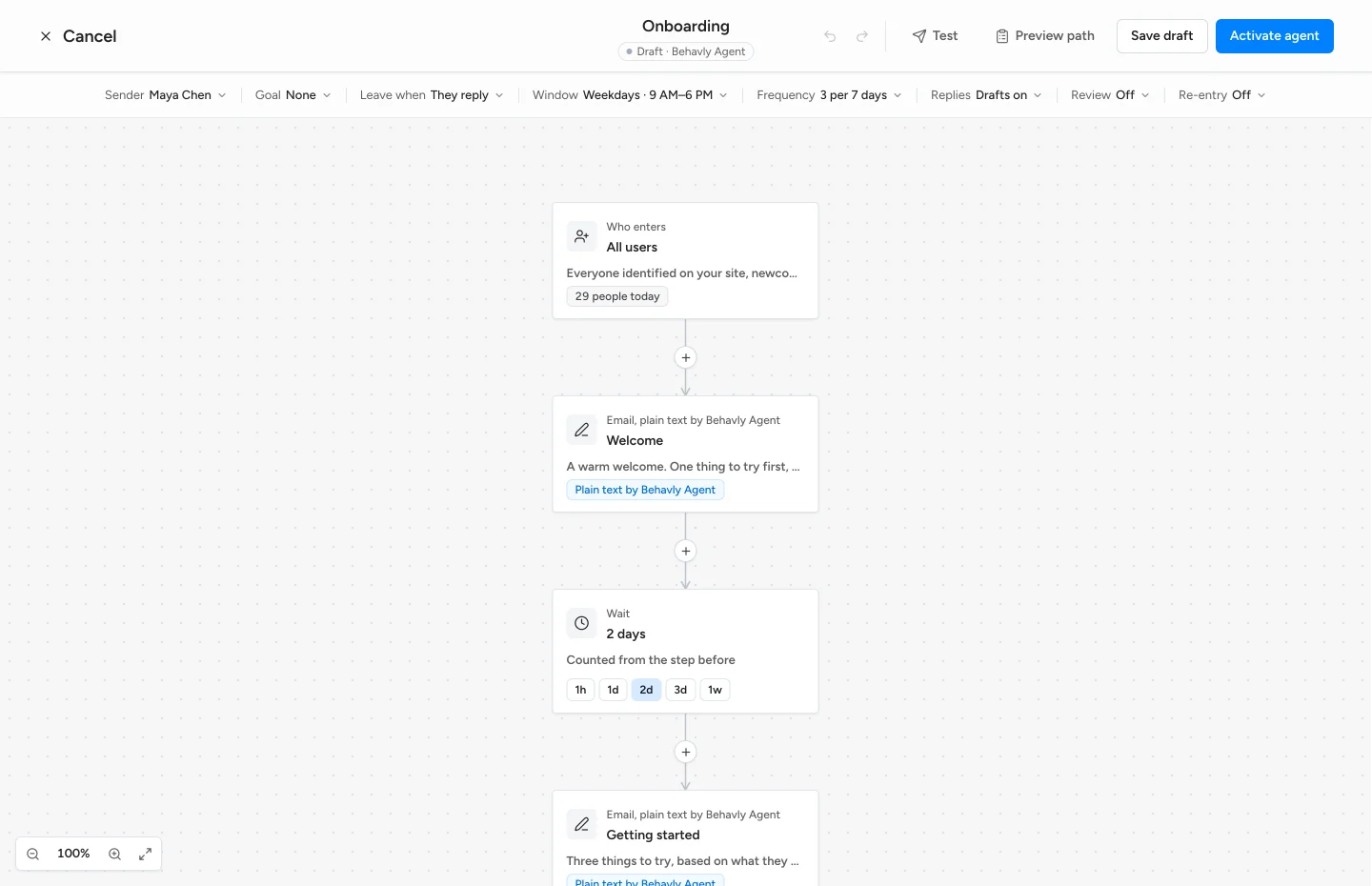
Behavly is behavior-based email for SaaS and other products people sign in to: describe a follow-up in plain words, and Behavly Agent writes each email from what that user did on your site, sent from your own mailbox or email service. It tracks what each signed-in user does in your product and builds the follow-up paths you describe. A path runs like this:
- 1Describe the path. In Automations, choose a Pattern Campaign or a Trigger Campaign, say who it’s for and what each email should do, and choose Build the path. Behavly lays out the emails, waits and branches; Undo brings the empty path back.
- 2Each email is written when it sends. A Behavly Agent step writes for one person from their activity, your Instructions for Behavly Agent and your Brand info, the only ground it has for what it says about your product. It reads every earlier email on the path and whether they opened or clicked it, so it says something new each time.
- 3The path moves on behavior. A wait can last until the person does something, and a branch splits on what they did. Only real actions count: Apple Mail loading images by itself isn’t an open, and a security scanner following a link isn’t a click.
- 4You check, then activate. Preview writes any step for a real person without sending it, and Test sends the whole path to your inbox. Review is off by default; turn on Hold Behavly-written emails for approval and every written email waits for you.
- 5Limits hold across campaigns. Emails go out in the sending window you set. By default, different campaigns stay 24 hours apart and nobody gets more than 3 emails in any 7 days. Behavly doesn’t predict a best hour: the optional At each person’s usual hour counts when that person is usually on your site.
- 6Replies come to you. A reply ends the path and lands in the Inbox with the sender’s activity beside it, filed as High-intent, Follow up, Referral, Suppress or Replied. A suggested answer waits for you to check and send.
- 7The path reviews itself. Set a Goal and Behavly credits each person who reaches it to the last email they got. Every Monday, once a campaign has sent 20 emails, Path review suggests changes with the path’s own numbers. Nothing changes until you apply one.
What does an agent-written email look like?
Fieldwise is a made-up survey tool. The step’s instructions are the same for everyone who reaches it; the email is not.
Subject: Your customer survey is ready to send
Hi Jonas,
Your “Onboarding feedback” survey has its seven questions and a thank-you page, so it’s ready for its first responses. Paste in your customer list and Fieldwise sends each person their own link and shows you who has answered.
You can send yourself a test first.
Send your survey: [link]
Elena
Step instructions: “Get them to send their first survey. One step, one link.” Someone who had already sent a survey would have been skipped.
Running it from a chat: Behavly Agent and MCP
The same work can be done by asking. Behavly Agent, the chat built into Behavly, builds a campaign, finds a pattern, drafts a reply or reports how a campaign is doing, from your workspace as it is now. Anything that would create, change, delete or send something shows a confirmation card first and runs only when you choose Confirm. Every change is recorded in the audit log.
Outside Behavly, AI apps that support MCP, including Claude, ChatGPT, Gemini, Perplexity, Grok and Cursor, connect to Behavly’s MCP server and use the same actions, with your role and your plan’s limits. By default, deleting something or sending email to real people still waits for your approval in Behavly. To compare options, see MCP servers for email.
What to check before an agent writes your email
- Can you read the path? Every email, wait and branch should be visible and editable.
- What does it write from? Activity tied to the person and a description of your product, or only a name and a job title.
- Can you hold emails for approval? Start with it on, and read real emails before you trust a path.
- Are limits shared? A cap per person across every campaign, not only inside each one.
- Does a reply stop it? Someone who writes back is in a conversation, and the path should hand it to you.
Questions
- What is agentic email marketing?
- Email marketing where an AI agent decides, for each recipient, what the next email says and whether it’s still needed, and sends it inside rules you set: who can be emailed, when, and how often.
- Is agentic email the same as AI-written email?
- Not quite. AI-written email can be a draft a person edits and sends. Agentic email also acts: it writes each email when it sends, leaves out ones that are no longer needed, and moves people along a path by what they do.
- Can an AI agent send emails without approval?
- It can, so approval should be a setting you control. In Behavly, Review is off by default; turn on Hold Behavly-written emails for approval and every written email waits until you send or skip it.
- When does an email agent send each email?
- In Behavly, inside the sending window you set, in each person’s timezone and under the frequency limits. There is no send-time prediction; the optional usual-hour setting counts when that person visits your site.
- Can I run Behavly’s agent from Claude or ChatGPT?
- Yes. Any AI app that supports MCP can connect to Behavly’s MCP server and use the same actions as Behavly Agent, with your role and your plan’s limits.